
Beard Strategies Case Study
Product
Internal Legal Writing Portal | B2B
Sector
Legal Technology | Consulting Services
My Role
- Workshop Facilitation
- Research
- Information Architecture
- UI Design
My Team
- Senior Software Engineer
- Project Manager
- Product Designer (myself)
- Developers
- Quality Assurance
Main Goal
To empower legal writers and revisors to produce law firm performance reports more quickly and efficiently.
About
Beard Strategies is a coaching and consulting firm that supports law practices in developing, retaining, and advancing talent. Through leadership reviews and assessments, executive coaching, career transitions, and organizational strategy, they provide thoughtful feedback and practical guidance that helps lawyers and firm leaders grow, build stronger teams, and navigate change with confidence.
The Challenge
Beard Strategies needed a modern, secure writer portal to support their team of writers and revisors producing reports based on sensitive law firm interviews. Their existing system was outdated and inefficient, pushing users to rely on third-party tools like ChatGPT and external text editors to meet deadlines.
While Beard recognized the productivity gains AI tools offered, they were increasingly concerned about confidential legal information leaving their controlled environment. At the same time, the project faced tight budget and timeline constraints, with work cycles fluctuating between interview-heavy periods and fast-paced writing sprints tied to client deadlines. Adding to the urgency of the project needs, Beard had just secured a major client and needed the new portal launched quickly to ensure a strong first impression and scalable workflow from day one.
The new writer portal needed to include:
- A centralized writing environment that reduced context switching and eliminated reliance on external editing tools
- Secure, AI-assisted workflows with configurable AI summary prompts and testing tools, enabling efficiency while keeping confidential legal data fully in-house.
- Streamlined writing and revision flows designed to support tight, deadline-driven production cycles
- Clear, real-time status tracking across drafting and editing phases to improve visibility and accountability
- Administrative tools that surfaced project assignments, highlighted unassigned or stalled work, and helped prioritize reports requiring attention
- A comprehensive, audit-ready history of document changes across the full lifecycle of each report
- Usability improvements that preserved familiar workflows from the legacy system, ensuring the new tool felt intuitive and non-disruptive for both new and existing team members
- A modernized UI that reduced friction and improved clarity without alienating long-time users
The Approach
First, my team and I began building a product strategy by defining the levels of success:
- Impacts: What broader, long-term difference will we make?
- Outcomes: What changes will users or the business experience as a result of our work?
- Outputs: What tangible deliverables will we create?
Next, we collaborated on applying IDEO’s Desirability, Viability, and Feasibility (DVF) framework to shape guiding key questions:
- Desirability: Will people use the product, and why?
- Viability: What is the business value of the product?
- Feasibility: Is the product technically possible to create?
While the team contributed across all three areas, my main focus was desirability, where I generated many of the guiding questions with our core personas in mind: writers, revisors, and the admin. The specific questions I explored included:
- Will writers and revisors adopt the writer portal as their primary workspace?
- Will the new writer portal improve an individual’s writing and revision flow?
- Where do current writing and revision workflows break down?
- How can the writer portal reduce context-switching between documents, notes, and external tools?
- What safeguards are needed to support AI-assisted writing without compromising confidentiality?
- How can revision cycles be made clearer and more efficient for the admin?
The Discovery
Once the product strategy was approved and the project moved into active work, I shifted focus to discovery to ensure we were solving the right problems from the start. This phase was about building shared understanding by learning how the current system was actually being used, where it was falling short, and what the stakeholder hoped this new tool could become. The work here set the foundation for the conversations, collaboration, and design decisions that followed.
Stakeholder Alignment and Legacy System Review
I began by working closely with the primary stakeholder to understand her vision for the new tool and the outcomes she wanted to achieve. Through multiple one-on-one sessions, often joined by the senior software engineer, I asked targeted questions to map her current workflow and define the ideal end-state experience. These sessions included detailed walkthroughs of the legacy system, which helped surface friction points, inefficiencies, and outdated interaction patterns. While the system provided important context, we were intentional about not carrying forward interactions or assumptions that slowed users down or added unnecessary complexity.
Translating Stakeholder Insight into Early Concepts
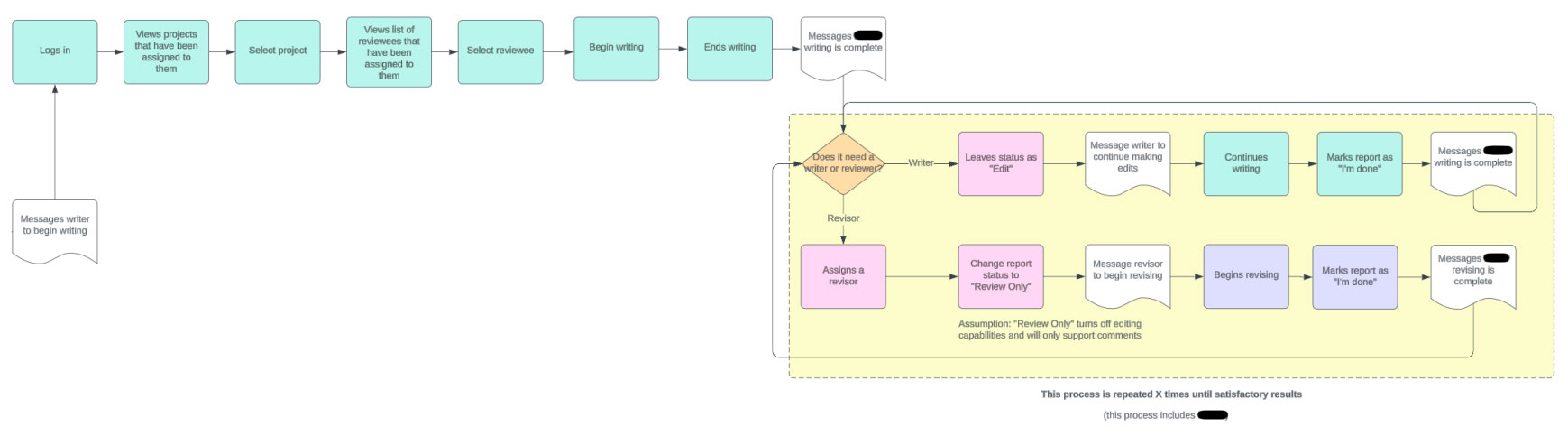
With a clear understanding of the stakeholder’s goals and the challenges within the legacy system, I made sure I was tied at the hip with the senior software engineer to begin shaping potential solutions. Before moving into high-fidelity design, I created whiteboard sketches and flow diagrams that explored how current-state workflows could evolve into simpler, more intuitive experiences. Working side by side allowed us to pressure-test ideas early. The senior software engineer helped validate technical feasibility and surface constraints, while I focused on usability, clarity, and long-term scalability. This close collaboration ensured we approached visual design with a shared understanding.
Understanding User Goals, Motivations, and Pain Points
To design an effective writer portal, it was crucial to understand the needs of writers, revisors, and the admin stakeholder, since the success of the platform depended on smooth collaboration across all three roles. While their responsibilities differed, all users shared a common goal of producing high-quality, accurate reports efficiently and on time.
Writers and revisors were primarily focused on working quickly and clearly with interview data, minimizing friction during drafting and revision cycles, and maintaining consistency across reports. The admin, who also served as the primary stakeholder, needed visibility and control over report status, assignments, and completion to ensure deadlines were met and deliverables were client-ready.
Across roles, users were motivated by saving time, reducing cognitive load, and avoiding unnecessary back-and-forth. However, the legacy system’s fragmented workflows, limited collaboration support, and lack of clear status tracking created friction, slowed delivery, and pushed users toward external tools. These insights helped shape a solution that balanced individual productivity with shared oversight and accountability.
Writer & Revisor Goals
- Efficiently transform raw interview notes into clear, well-structured reports
- Collaborate smoothly across drafting and revision cycles
- Maintain consistency in tone, structure, and quality across reports
- Complete assignments on time without unnecessary rework
Writer & Revisor Motivations
- Reduce time spent on formatting, version tracking, and manual copy edits
- Focus energy on writing and content quality rather than tool limitations
- Feel confident that their work is accurate, complete, and client-ready
- Work flexibility across roles, since writers often also act as revisors
Writer & Revisor Pain Points
- Fragmented workflows that required switching between multiple tools
- Confusion around which version of a report was the “latest”
- Repetitive copyediting tasks that could have been streamlined
- Limited visibility into report status, expectations, or next steps
Admin Goals
- Oversee all reports in progress and completed work at glance
- Assign reports to the appropriate writers or revisors
- Ensure reports meet quality standards before being finalized
- Clearly mark reports as officially completed and ready for export
- See unassigned reports and who has been assigned previously
Admin Motivations
- Maintain consistency and quality across client deliverables
- Reduce bottlenecks and delays during busy interview cycles
- Minimize manual follow-ups with writers and revisors
- Feel confident that nothing slips through the cracks
Admin Pain Points
- Limited visibility into report ownership, progress, and status
- Difficulty tracking when a report was truly finished versus “almost done”
- Manual coordination required to reassign or prioritize work
- Lack of clear system indicators for approval and completion
The Definition
In the definition phase, I translated the discovery insights into a clear design direction for the writer portal. This involved prioritizing the most critical writing and revision workflows, aligning on the needs of writers, revisors, and stakeholders, and establishing a foundation for how content would be created, reviewed, and secured within the platform. The goal was to create a focused blueprint that kept the team aligned and ensured the design remained grounded in both user needs and business constraints.
Information Architecture
I focused on creating an information architecture that supported a fast, focused writing workflow while giving administrators clear visibility into report status, ownership, and priority. Writers and revisors were often working under tight deadlines, juggling multiple reports at once, while admins needed to coordinate and ensure work smoothly from draft to delivery. The legacy system provided little clarity into where a report stood or who was responsible for the next step.
Rather than organizing the platform around isolated features, I aligned the information architecture to the non-linear lifecycle of a report, where drafts move fluidly between writers and revisors over multiple rounds. Each report was treated as a living artifact that moved through clearly defined states, making both individual contribution and overall progress easy to understand at a glance.
Key information architecture decisions included:
- Lifecycle-based report structure, allowing admins to see who had worked on a report, where it currently lived in the workflow, and who needed to be assigned next
- Priority and scoring visibility, surfacing report priority levels and evaluation scores directly within view to support better planning and decision-making
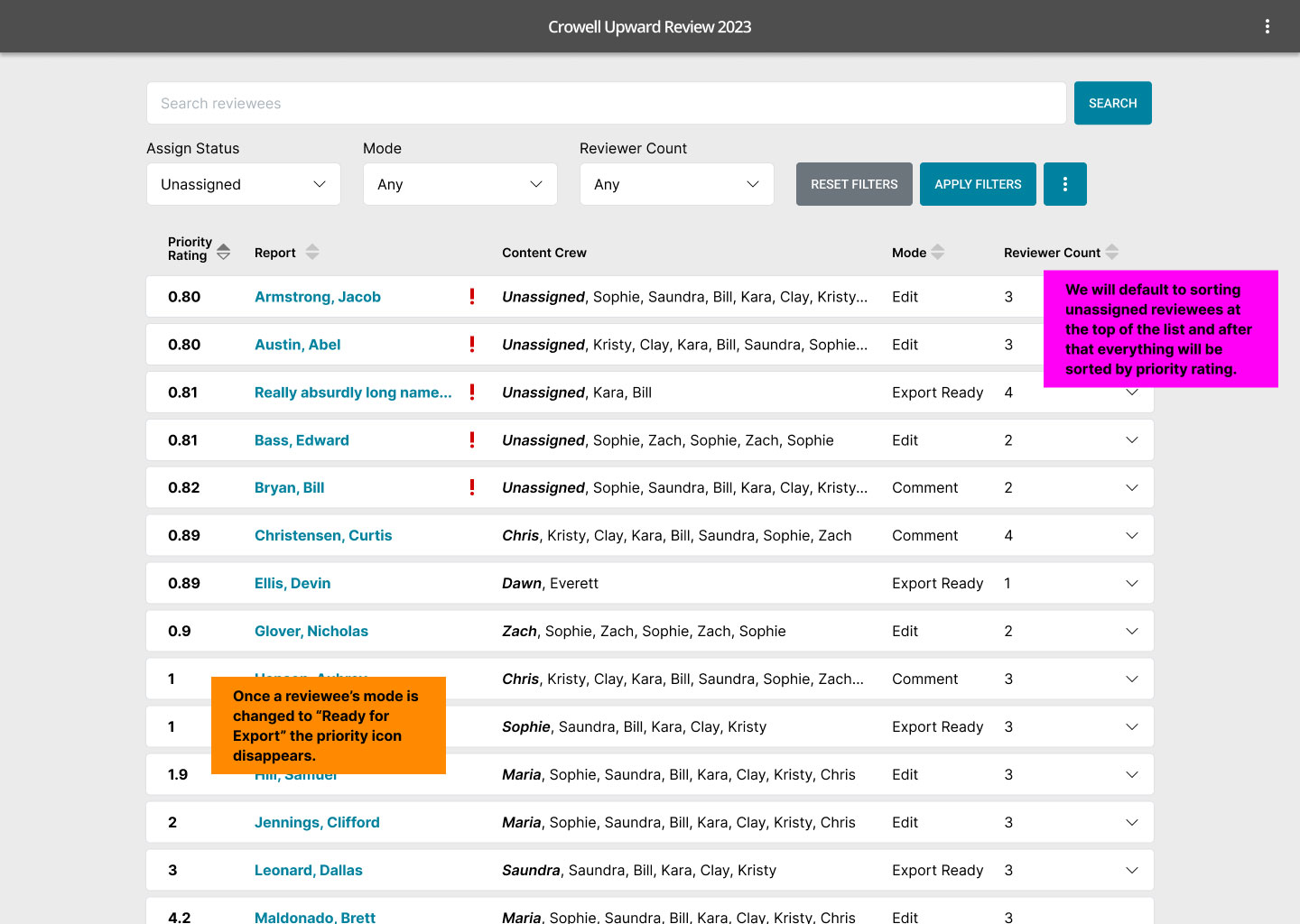
- State-based project modes, enabling reports to be clearly marked as editable, revise-only, ready for export, and exported, reducing confusion and preventing accidental changes
- Archive pathways, giving admins a clear way to close out completed work without losing historical context
Through this process, I intentionally avoided replicating the shortcomings of the legacy system. While it served as a reference for existing constraints, the new information architecture was designed from the ground up to emphasize clarity, accountability, and scalability. This structure gave administrators confidence in managing workloads and timelines, while allowing writers and revisors to stay focused on their tasks without unnecessary friction. The result was a calmer, more predictable system that could grow to support additional clients, report types, and future AI-assisted workflows without collapsing under the weight of ad-hoc complexity.
The Design
In the design phase, I translated strategy into execution by designing a focused document-centric writing experience tailored to how writers and revisors actually work. Rather than treating reports as static forms, the interface was built around a structured yet flexible narrative editor, supported by contextual prompts, scoring visibility, and AI-assisted drafting tools. Alongside this, I designed clear status and review controls that allowed work to move smoothly from draft to final version without losing clarity or ownership. The resulting experience balanced structure with editorial freedom while maintaining consistency, security, and speed across the reporting lifecycle.
Solutions Designed
The Beard Strategies Writer Portal was redesigned to support the full life cycle of a report, from raw interview responses to a polished narrative summary. Each solution was informed directly by how writers, revisors, and admins interacted with reports on a daily basis.
Writers & Revisors Solutions
- Problem: Writers and revisors needed to synthesize structured interview data into clear, cohesive narrative summaries, but the legacy system forced them to juggle multiple tools, tabs, and document versions. Navigation between questions and sections were cumbersome, feedback was difficult to track, and it was often unclear when a report was ready for revision or finalization.
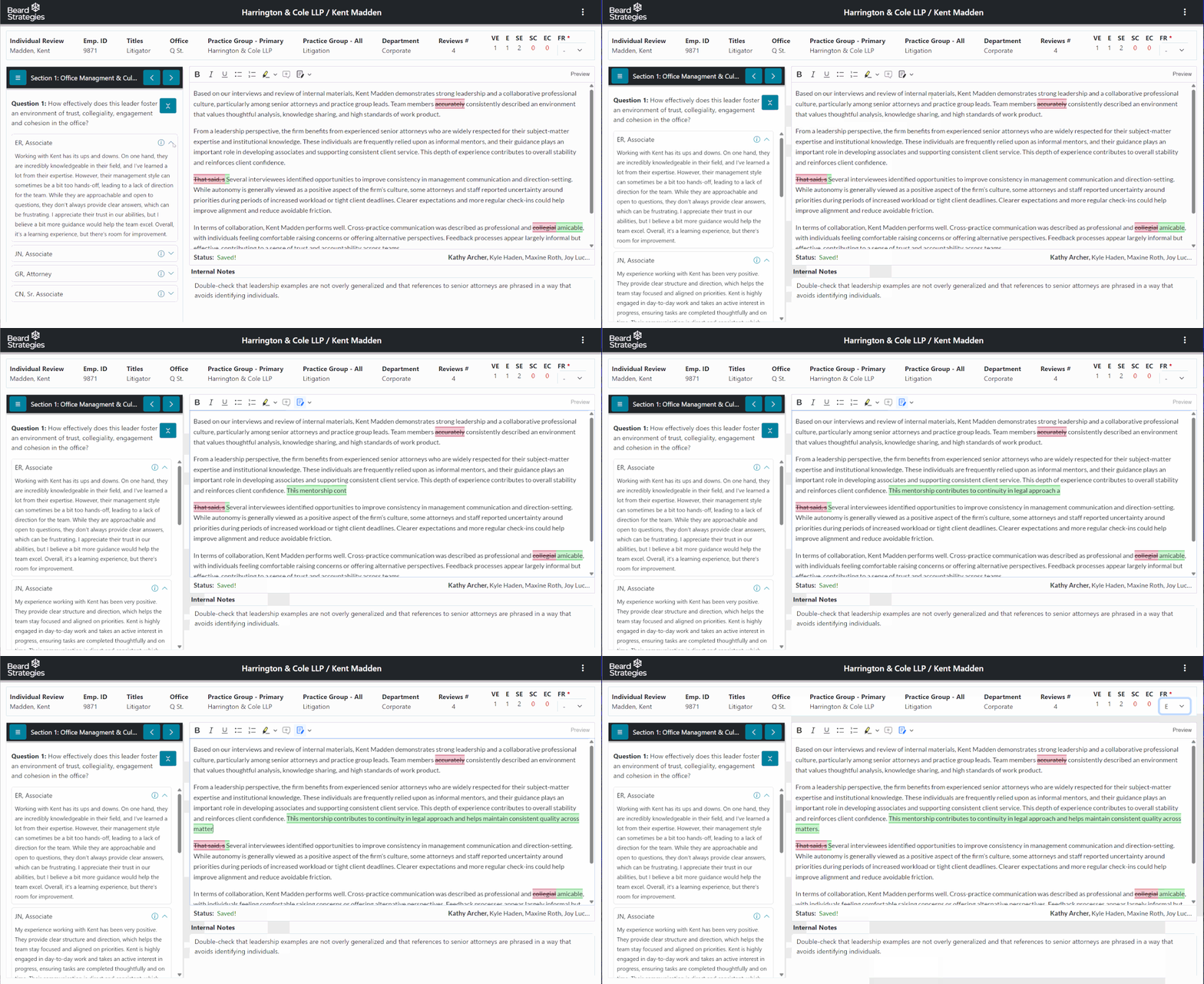
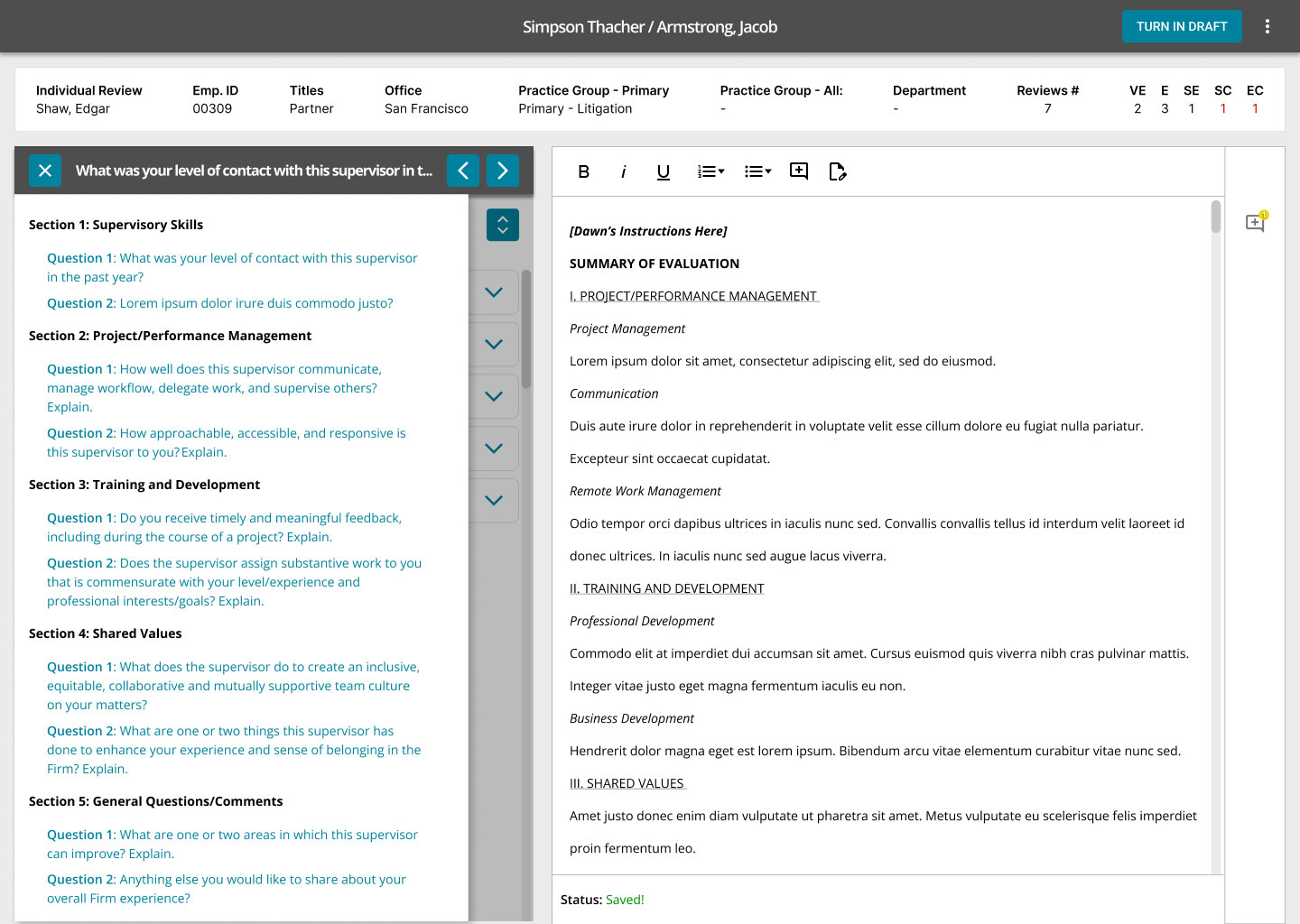
- Design: I designed a unified writing interface that paired structured inputs with a full narrative editor. Key elements included:
- A left-hand panel that anchored writers in the evaluation structure, allowing quick navigation between sections and questions without breaking focus.
- A primary editor that supported long-form narrative writing, formatting, and inline refinement
- AI-assisted summary tools that helped generate and compare different narrative drafts, giving writers a strong starting point without replacing editorial judgment
- Clear indicators for report status so writers and revisors always understood what actions were available
- Consistent layouts and controls so both roles could move between writing and revising with minimal friction, even though their responsibilities differed slightly
- Impact: Writers and revisors could focus on synthesizing insights rather than managing tools or formats. The structured navigation and narrative editor worked together to speed up drafting, improve clarity, and reduce rework, while AI-assisted summaries helped teams move faster without compromising quality or confidentiality.
Admin Solution
- Problem:
Admins needed visibility into report progress, quality scores, and contributor history, while also ensuring that AI-generated summaries were accurate, consistent, and appropriate for sensitive legal content. They lacked a centralized way to understand a report’s status and safely control how AI outputs were generated and refined. - Design: I designed admin-facing controls and metadata displays that surfaced critical context directly within the report view, alongside tools for configuring and testing AI summaries. Admins could:
- See report ownership, reviewer counts, and scoring dimensions at a glance
- Track who contributed to a report and how it progressed through drafting and revision
- Change report modes to control handofs and prevent accidental edits
- Archive completed reports while preserving historical context
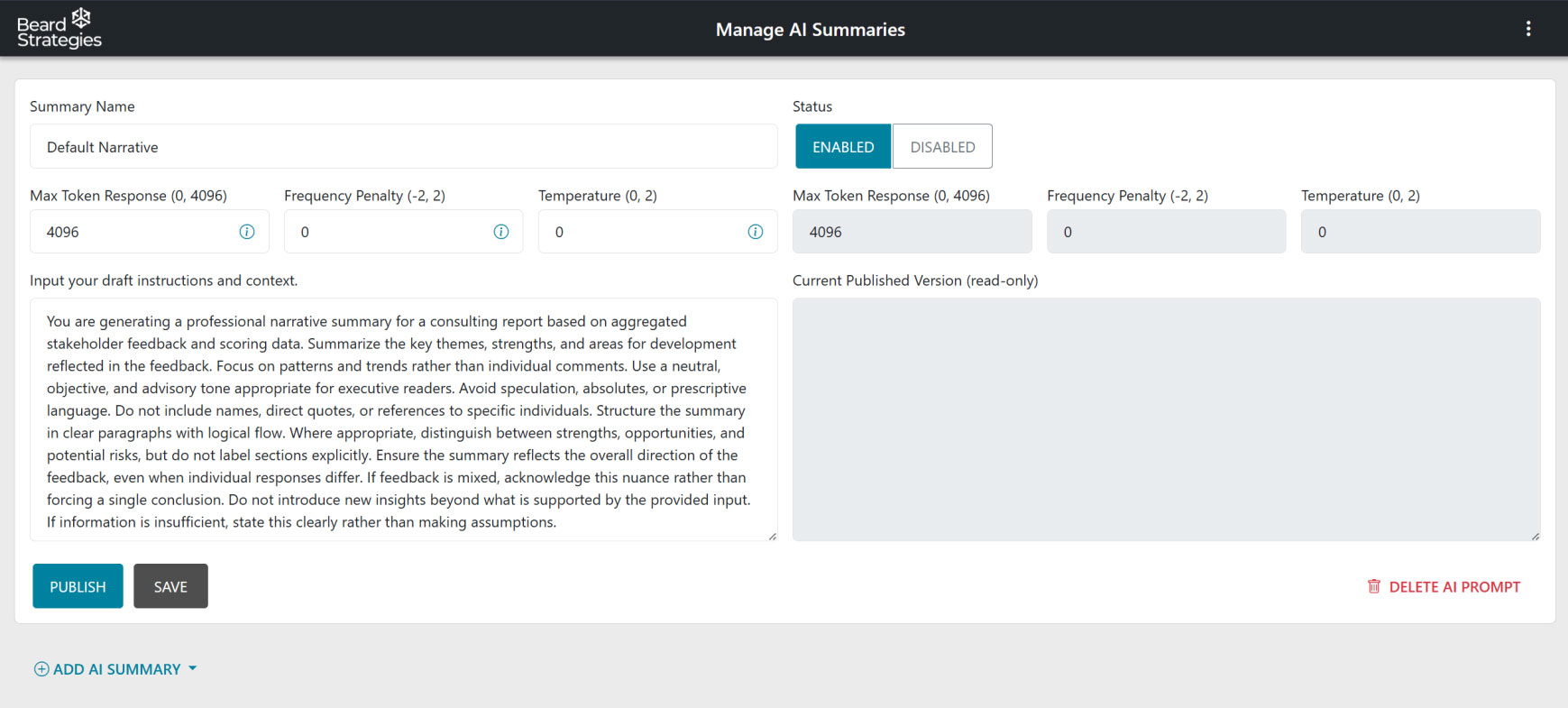
- Create and manage reusable AI summary templates by defining prompt instructions, output length, and tone
- Test AI summaries directly in the writer interface to evaluate clarity, accuracy, and risk before publishing for broader use
- Iterate on AI behavior safely, allowing prompt refinements without exposing writers to raw prompt engineering or external tools
- Impact: Admins gained clear oversight into both report health and AI-assisted output without interrupting writers or revisors. This reduced bottlenecks, improved prioritization, and ensured reports and their AI-generated summaries moved efficiently from draft to delivery while meeting quality and confidentiality expectations.
My Design Process
I approached the writer portal with a pragmatic, workflow-first design process focused on clarity, efficiency, and consistency rather than visual polish. Since the product was a desktop-only web application, my designs centered on optimizing dense content layouts, writing tools, and review states for sustained, focused use. I created lightweight, reusable Bootstrap-based components in Figma and aligned the interface closely with CKEditor to ensure the editing experience felt familiar and cohesive with the underlying text-editing tools. Fidelity intentionally lived between low and high, allowing us to validate structure, hierarchy, and interactions without over-investing in branding that was out of scope. Throughout the project, I met weekly with the primary stakeholder to review designs and refine workflows, and shared monthly progress with the CEO to ensure alignment at a leadership level. This iterative cadence allowed the product to evolve steadily while staying tightly grounded in real user and business needs.
The Delivery
The redesigned writer portal was prepared for development with a strong emphasis on clarity, security, and alignment across writers, revisors, and administrators. During delivery, my role focused on producing detailed design documentation, workflow diagrams, and interactive prototypes that clearly communicated complex writing, review, and approval states to the engineering team. I partnered closely with stakeholders to ensure the solution supported immediate operational needs, such as report turnaround and administrative oversight, while remaining flexible enough to accommodate future enhancements, including expanded AI-assisted workflows and reporting features. Although the project concluded before full implementation, the delivery artifacts established a clear, cohesive foundation that enabled the team to move forward with confidence.
Performance Evaluation & Metrics
While formal analytics were not fully implemented at launch, the writer portal was designed around clear, outcome-driven success criteria tied to Beard’s operational efficiency and content quality. If tracked, performance would have been evaluated through a combination of workflow metrics and qualitative feedback.
Key success indicators included:
- Faster report turnaround: Measuring time from assignment through writing, revision, and final export. Shorter cycles would signal that clearer workflows and task visibility were reducing friction across teams.
- Increased writer and revisor throughput: Tracking reports completed per contributor over time. Gains here would reflect reduced context switching and less dependence on external tools.
- Improved operational scalability: Assessing how efficiently new clients could be onboarded without increasing administrative overhead. Informally, I heard that Beard was able to onboard more clients and complete reports faster after launch. This was an early indicator that the portal was supporting growth and efficiency.
Together, these metrics would have provided a clear picture of design impact, helping validate outcomes, surface opportunities for improvement, and guide ongoing iteration as the platform scaled.